When the opportunity finally arrives for me to direct the first all-grape cast in a production of the French composer Jules Massenet‘s 1899 opera, Cendrillon, based on the French author Charles Perrault‘s 1698 folk tale of the same name, you can count on me to hand the starring role of Cinderella to Burgundy’s under-appreciated aligoté grape. And it won’t be because the white wine made from it (commonly called Bourgogne Aligoté) has the taste of rags and the texture of cinders (it does not) or the texture of rags and the taste of cinders (it does not).
The Cinderella leitmotif of neglect and oppression followed by recognition and reward is as old as the hills, appearing in Asian rags-to-riches tales from the 9th century and in ancient Greek ones from as far back as the 1st century BC, apparently. My bathroom copy of Buddhism for Sheep includes a number of inspirational — and, I’m sure, ancient — proto-Cinderella nuggets, such as “There are two ways of looking — a right way and a wrong way,” “Those who act well and have good karma will be reborn into happiness,” and my personal favorite, “The stinking pen and the fragrant rose are two aspects of the same existence.”
In his version of the Cinderella tale, Perrault introduced the popular fairy godmother, the pumpkin carriage, and the essential glass slippers that we all know and love today. In its blockbuster 1950 animated film, Walt Disney Productions added many of the talking animals, including the mice sidekicks, Jaq (aka Jacques) and Gus (aka Octavius), which we also know and love. In their 1971 musical story book and record about Cinderella, the Peter Pan Players and Orchestra introduced memorable ditties like “Work, Work, Work” and “Nobody Fits the Shoe,” which I know and love because we had that musical story book in our house when I was growing up.
“Work, Work, Work” resonated with me especially because it summarizes my attitude towards household chores and work in general, both at the age of five and today:
Work, work, work!
I try not to complain.
Washing, mending, stretching, bending.
Everyday’s the same.
Work, work, work!
I try not to complain.
Sweeping, dusting, cooking, SCRUUUUB-ing…
Disney has also put out a number of Cinderella audio-enhanced books over the years, including one with memorable cues from Neverland native, Tinker Bell. You knew it was time to turn the page when she rang her little bell like this: “Tinker! Tinker! Tinker!”
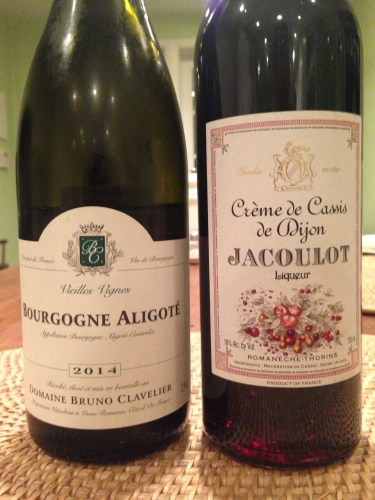 But about Burgundy’s aligoté: Like Cinderella, it’s been maligned, neglected, and overshadowed for years by pinot noir and chardonnay, Burgundy’s two preferred grapes (and the leading contenders for the roles of Cinderella’s ugly stepsisters in my all-grape production of Massenet’s opera). It’s best known — and typically used — as the base for the cocktail, Kir, a concoction of it and crème de cassis (blackcurrant liqueur) named after Félix Kir, a former mayor of the Burgundian city of Dijon and member of the French Resistance during World War II.
One of the unintended consequences of tarting up aligoté beyond recognition with blackcurrant or another fruit-based liqueur has been its devaluation as a wine worth drinking on its own. The New York Times wine critic Eric Asimov is one of a handful of wineknowers who, in Prince Charming fashion, have recently come to aligoté’s rescue. As Asimov points out in this July 2017 review, aligoté goes with just about everything… from, I would add, your best dazzle outfit to those ratty old sweat pants you’ve been holding onto since college. [Comment: You know who you are. End Comment.]
I first met aligoté through Kir (the cocktail, not the mayor) in Paris in the summer of 1987. My fellow American and Swiss stagiaires (trainees) and I were celebrating our recent liberation from an oppressive architectural conservation chantier (work site) at the 14th-century Abbaye Royale du Moncel between the communities of Pontpoint and Pont-Sainte-Maxence in the northern French department of the Oise in Picardy.
I remember the July 27th liberation celebration at the Restaurant du Théâtre like it was yesterday. [Comment: Having the menu and the bill from that evening more than 30 years ago certainly helps. Remarkably, I had the foresight back then to mark my courses in red ink. End Comment.] I had the mushroom salad with fresh mint, followed by the roasted duck breast with sauteed potatoes and market vegetables. Yummy!
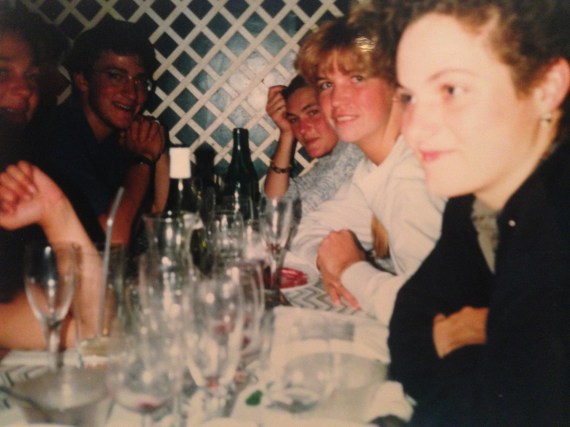
This out-of-focus photograph captures the tenor of that evening and the commanding role Kir and other French beverages played in it:
For the Dutch and Swiss kids at the Abbaye Royale du Moncel that summer, the chantier was a place for their parents to park them for a couple months while they enjoyed their adult vacations. For the six of us from the United States, it was a unique cultural immersion and a cool thing to add to our skimpy resumes. For the French it was, by and large, a place to dump juvenile delinquents from the public housing projects in the Parisian suburbs temorarily.
We worked our fingers to the bones eight hours a day, six days a week, on various masonry restoration projects at the abbey. I spent a lot of time working on the floor of the abbey’s wine cellar. [Comment: I know! What were the odds of that happening?! End Comment.] Those stone pavers were heavy. I get a twitch in my lower back just thinking about them.
Since we didn’t have any talking animal sidekicks to console us during the darkest hours of our misery, we recited passages from Monty Python and the Holy Grail to mask our mounting physical and emotional pain. Once we realized that our French overlords didn’t quite understand Monty Python one-liners, they became our secret code.
We lived communally in flimsy tents (it rained a lot that summer), had to walk a mile into town to shower, and took turns on KP duty cooking for more than 20 and cleaning up afterwards.
We created lyrics about being on KP and set them to the melody of “Singin’ in the Rain”:
I’m faire-in’ la vaisselle, just faire-in’ la vaisselle.
And after I’m finished, I’ll vider la poubelle.
With a smile on my visage, I’ll éviter la stage.
Just faire-in’, just faire-in’ la vaisselle.
[I’m doin’ the dishes, just doin’ the dishes.
And after I’m finished, I’ll empty the trash can.
With a smile on my face, I’ll escape this traineeship.
Just doin’, just doin’ the dishes.]
Here is a picture of us on KP duty at the abbey. It doesn’t look like anyone was in the mood for singing that day.

About three quarters of the way through the stage, personal possessions started disappearing from our tents. Money. Watches. Cameras. Portable radios. We knew at that moment that the chantier had turned a corner and that we had to break out of the place. Those of us who still had our watches synchronized them in preparation for an early morning escape on a specified date.
Luckily for us, we, like Cinderella, had our own fairy godmother on the morning of July 27th, 1987. Yvette, an adult volunteer from the village, showed up with a getaway car (it was a white station wagon, not a pumpkin carriage) and drove us to the station so that we could catch the train to Paris. Once in the City of Light, we checked into a hostel on Rue Pelican. Then, we headed out for a celebratory feast and what would turn out to be our first Kir made with aligoté.



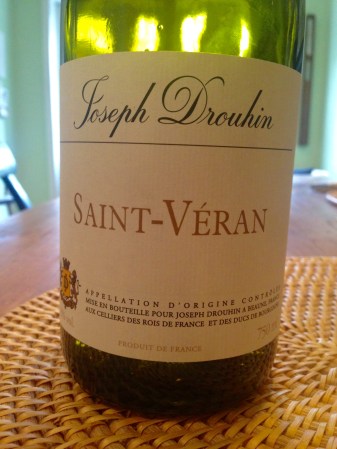 About Saint-Véran, the delightful, unoaked AOC white wine from southern Burgundy: The real village of Saint-Véran is high up in the French Alps, on the border with Italy. It is nowhere near the vineyards southwest of Mâcon where they grow the Chardonnay grapes to make the wine.
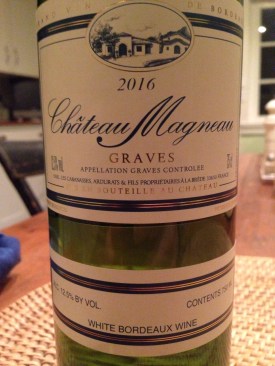 I went out to dinner recently with a group of associates and one of them ordered a “grave.” I was feeling more hopeful about the future that evening, so I ordered a glass of rosé.
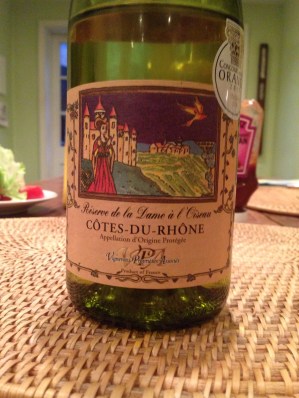 Which brings me to the
  Most likely a figment of the German imagination (like

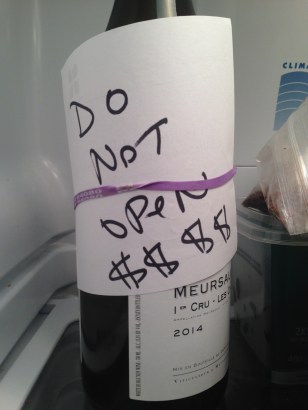 Since both wines are pricey, I went with the cheaper (and cuddlier) Meursault so that I won’t have to eat ground glass patties between slices of cardboard this weekend. I’ve also marked the bottle in the refrigerator so that it doesn’t inadvertently wind up in a casserole or a sauce, which has happened to fine wines here in the past.
 Whenever I think of the mouth of the
  I was talking about the wine