
 Whenever I think of the mouth of the Loire River in western France, my mind goes immediately to the Cloaca Maxima, the great sewer of Ancient Rome, 1,700 kilometers away in Italy. In its time more than 2,000 years ago, the Cloaca Maxima drained tons of effluvia from the marshes and streets of the Eternal City and into the Tiber River. It still functions, and every so often people camp out there [Comment: If interested in seeing it in person, go during the day. End Comment.]
France’s longest river has to empty itself out into the ocean somewhere, and lucky for us the forces of commerce, politics, history, and wine geography aligned in such a way over the centuries that the mouth of the Loire today is the leading producer of Muscadet, the immensely popular dry white AOC certified wine made from the obscure melon de Bourgogne (aka “melon”) grape.
If I were a grape and someone called me a melon, I’d be pretty upset.
In the French-speaking world, “tête de melon” (translated, melon head) is an insult. “J’ai le melon” means that I have a swelled head or a big ego.
But not at the mouth of the Loire.
In Nantes, the major port in the region, it could mean, “I’m having the Muscadet.”
During the 17th century, Dutch merchants loved the Muscadet wine made from “melon” grapes so much that they encouraged their cultivation around Nantes, making it cheaper, quicker, and easier for them to export to the Low Countries, and where they frequently distilled it to make brandy. [Comment: Look at any Dutch genre painting from the period, and you’ll see how much they enjoyed the brandy. End Comment.]
The “Bourgogne” in the name indicates that the varietal is native to Burgundy in eastern France, but you won’t find much of it growing there these days. The “melon” vineyards of Burgundy were reputedly ordered by royal decree to be destroyed in the early 18th century, further concentrating the cultivation of “melon” grapes at the river’s end.
The melon de Bourgogne grape is hardy, thick-skinned apparently (it would have to be, especially on the playground), and can tolerate the coastal climate, which is another reason for its prevalence in the region. It also grows well in Oregon.
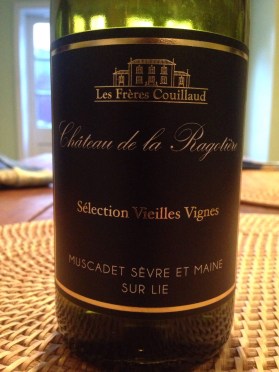
Some of the better Muscadets are fermented “sur lie,” meaning that they are left to age on the wine skins for a while before going directly into the bottle, which enhances the texture of the wine and gives it a little fizz.

 I was talking about the wine