
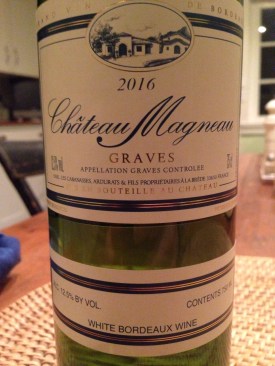
 I went out to dinner recently with a group of associates and one of them ordered a “grave.” I was feeling more hopeful about the future that evening, so I ordered a glass of rosé.
Correctly pronounced, Graves is GRAWve. You can listen to a French pronunciation of it in this short audiovisual presentation, one of 241 French wine names recorded on the Learn French from Vincent channel on YouTube.
Under ordinary circumstances, I wouldn’t poke fun at someone’s mispronunciation of a French word. [Comment: What am I saying?! Of course I would! Ha ha ha! End Comment.] But these aren’t ordinary circumstances. I’ve been there. I’ve been locked in an epic tug of war with the French and their language for most of my adult life.
During my first visit to the Musée d’Orsay in Paris (I was 19 years old at the time), I had joked with my companions that a gallery of prints by the French painter, Odilon Redon, had been “redone.” Immediately, a French woman appeared from out of nowhere and corrected me.
“Non,” she said. “Eat’s Ray-DAWN.”
And then she disappeared.
The Orsay-Redon Incident was in August 1987, but by that time the struggle was already a month underway. “I have had it! Whenever I go to speak French I goof up… If I could leave I would, but I don’t want to carry my bags, and I’ve spent all my money for this.” I wrote that in my journal on July 17, 1987–four days into my first trip ever to France and a month before Orsay.
Out of laziness I suppose (I didn’t want to carry my bags???), I stuck it out through the rest of the summer as planned. Though I vividly remember Orsay-Redon down to the color of the gallery walls, after a month I had already gotten enough black eyes for intentionally and unintentionally mispronouncing French words and phrases that I shrugged it off, resolved to do better next time, and moved on to the next confrontation.
For some people, the fear of mispronouncing French words and wines, combined with a lack of familiarity with French geography, might be a barrier to trying them. The French tradition of naming and certifying wines by French place name as opposed to grape (Vouvray as opposed to Chenin Blanc, for example) made sense when the market for French wine was mostly domestic. It’s a bit more complicated now that the biggest markets for French wines are outside of France, which is one of the reasons you see the names of grapes appearing more regularly on French wine labels. A French Chardonnay is more accessible to non-francophones in China and the United States than a Mâcon-Villages, even though they’re the same thing.
About Graves, the AOC certified white wine from Bordeaux, where the Garonne River meets the Atlantic: It’s a bit limestoney, but it’s what you’d expect from a wine produced in a sub-region that likes to tout its gravely soil (it’s part of the terroir). This Château Magneau Graves is made from a blend of Sauvignon Blanc, Sémillon, and Muscadelle grapes native to the west of France. Château Magneau’s old-school wine label doesn’t list them: We’re just supposed to know that.
If you’re into caressing stone columns like I am (I picked up that bad habit from an American I had met in a medieval cloister somewhere in France), then you’ll definitely dig a Graves.
NB: And in case you were wondering, I do know that Pouilly is properly pronounced “Poo-yee.” I left off the letter Y in previous posts for comedic effect!

 I was talking about the wine