
If I could have dinner and a bottle of fragrant Condrieu with anyone in the world, dead or alive, it would be with the late Luis van Rooten, alive.
He was not only one of the cleverest writers of the 20th century (more about that below) but also – among so many other things – an actor, an architect (he designed three post offices in Cleveland, Ohio), a military radio announcer during World War II, and a gifted homophonic translator.
Talk about versatile. How many people can say that they played the roles of the Nazi SS leader, Heinrich Himmler, twice AND the King and the Grand Duke in Walt Disney’s 1950 animated film, Cinderella?
He also had a delicious sense of humor.
Van Rooten was born in Mexico City, where his French-Mexican father worked as a translator and liaison for the American Embassy until he was assassinated on a train en route to California. His Belgian grandmother worked as a sort of lady’s maid for the wife of the Mexican president. During the Mexican Revolution, she fled north with little Luis, at the border claiming him as her son because he had no papers, which resulted in the outrageous elongation of his name to Luis Ricardo Carlos Fernand d’Antin y Zuloaga van Rooten.
After a brief time with relatives among their orange groves in Pasadena, he headed off to boarding school in western Pennsylvania, that All-American crossroads of hope and despair south of the shallowest Great Lake where the western Northeast meets the eastern Midwest.
[Comment: You can bet that the other kids at school taunted him with names like “van Rooten tootin'” and “tootin’ van Rooten.” It’s not easy growing up in rough and tumble western Pennsylvania with a name that rhymes with a word that describes “droppin’ a rose,” as they say in polite society and in some diplomatic circles. End Comment.]
Of his three books, I am most familiar currently with his 1967 classic, Mots d’Heures: Gousses, Rames (roughly translated as Words of the Hours: Roots and Branches), a compendium of 40 seemingly obscure French poems he had supposedly inherited in manuscript form from a deceased relative. I like verse no. 19 because it speaks to our shared interest (his presumed, mine avowed) in floriculture, roses in particular:
Raseuse arrête, valet de Tsar bat loups
Joues gare et suite, un sot voyou.
[Comment: Van Rooten’s other books are The Floriculturalist’s Vade Mecum of Exotic and Recondite Plants, Shrubs and Grasses, and One Malignant Parasite, and Van Rooten’s Book of Improbable Saints, an irreverent hagiography of lesser-known Christian saints, such as St. Dichotomy and St. Pickip the Czech. End Comment.]
Verse no. 19 from Mots d’Heures is said to be an account of an incident at the Russian Imperial court where a valet beats away wolves as the lady barber (the “raseuse”) is told to stop shaving the Tsar, a delicate operation considering the Imperial family’s history of hemophilia.
An accomplished voice-over artist and announcer, van Rooten never intended for his target audience – francophones and francophiles mainly – to probe this collection of poems too deeply for meaning. Instead, he meant for them simply to listen to the sounds as they are recited aloud. Take “raseuse,” for instance. It’s a homophonic approximation in French of the English word, “roses.”
[Comment: Can I stop dropping hints now? End Comment.]
I love roses in any language. During the nice seasons, I struggle daily to defend them against aphids, spider mites, black spot, powdery mildew, caterpillars, over-watering, under-watering, and others’ overzealous pruning. I also proudly display them as the wallpaper on my mobile phone and in numerous posts on Facebook and Instagram.
As a matter of fact, I recently bought this painting of roses from BRUSH Studio on Etsy:

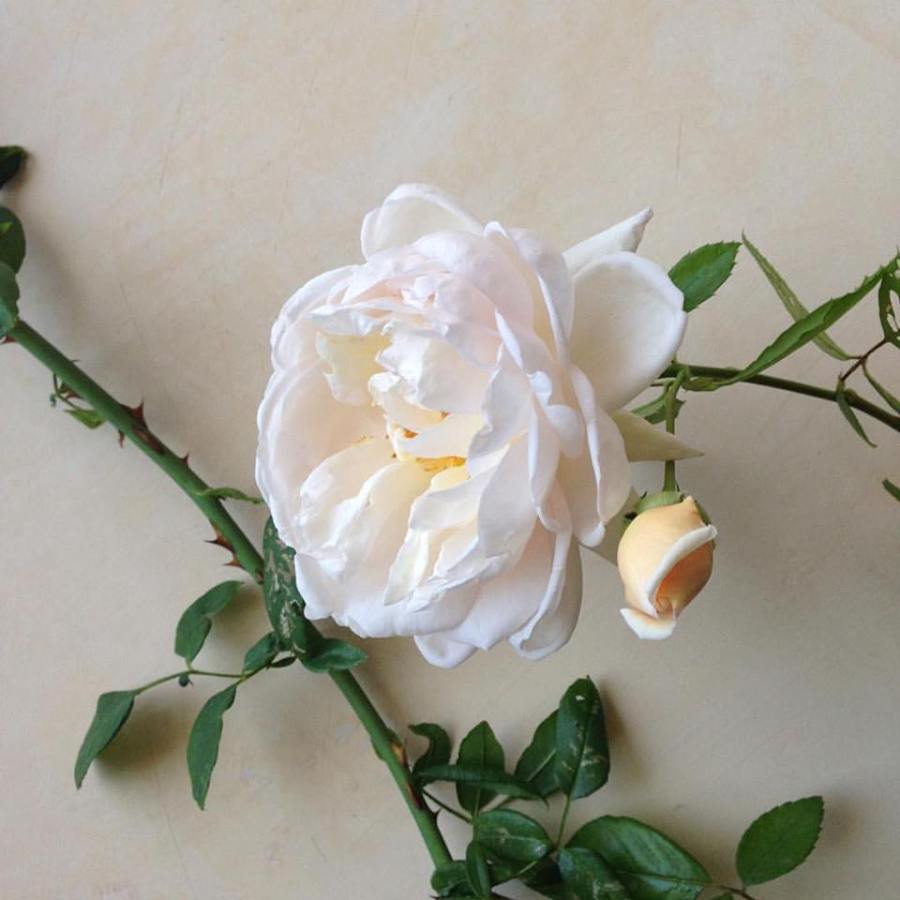
I call this one the Valmarana rose because I came across it last fall while trespassing in the courtyard of the privately owned Palazzo Valmarana in Vicenza, Italy:
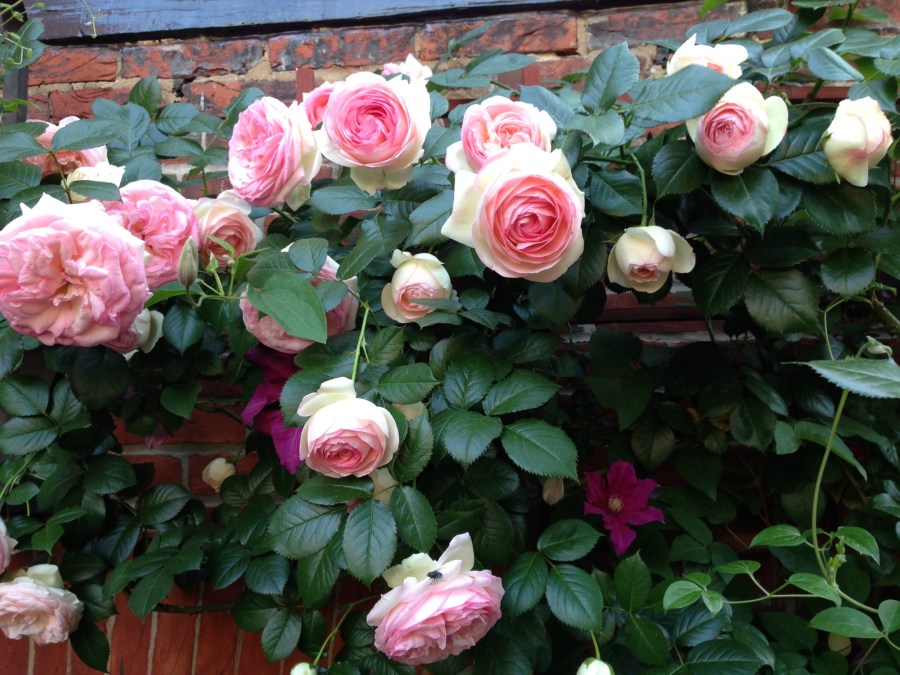
From about March to May each year, we toil to make this dazzle happen for two weeks and then toil from May to March to keep the bushes alive for the next round of toiling and dazzling:
I blame my anthophilia (love of flowers, not a hereditary blood disease) on my maternal grandfather, who for decades toiled in his garden of more than 50 rose bushes. Here’s a bird’s-eye view of a part of it, along with a photo of my grandfather taking a break from his rose-toiling:


About the Condrieu, the AOC-certified French white wine from the west bank of the Rhône: It’s pricey, produced in small quantities, and made from 100 percent viognier grapes.
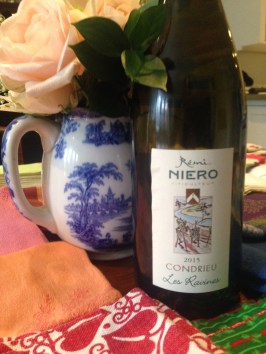
The full-bodied wines made from viognier can go in a number of unconventional flavor directions, from crushed gravel and beeswax to honeysuckle and potpourri according to Wine Folly. This Niero Condrieu surprised and delighted with its lovely floral aroma and hint of rose water. It’s like two weeks of May in a bottle, complete with blossoms from the Pierre de Ronsard climbers pictured above that frame the French-looking casement window and doors of our kitchen and cause us anguish year round.
Pierre de Ronsard was a 16th-century French aristocrat and prolific poet whose dream of becoming a diplomat was shattered by the onset of an incurable deafness. [Comment: As if that would have mattered. Most diplomats can hear only the sound of their own voice anyway. End Comment.] His “Ode à Cassandre,” a lyrical poem about a girl and a rose written in 1545 to the daughter of the wealthy Florentine banker, Bernardo Salviati, is the main reason the climbing rose, created in France in 1985, bears his name.
In brief, the ode is a gentle reminder that physical beauty, like a rose, eventually fades, so make the most of it while you’re young because it won’t last forever:
Mignonne, allons voir si la rose
Qui ce matin avoit déclose
Sa robe de pourpre au Soleil,
A point perdu cette vesprée
Les plis de sa robe pourprée,
Et son teint au vôtre pareil.
Las ! voyez comme en peu d’espace,
Mignonne, elle a dessus la place
Las ! las ses beautés laissé choir !
Ô vraiment marâtre Nature,
Puis qu’une telle fleur ne dure
Que du matin jusques au soir !
Donc, si vous me croyez, mignonne,
Tandis que votre âge fleuronne
En sa plus verte nouveauté,
Cueillez, cueillez vôtre jeunesse :
Comme à cette fleur la vieillesse
Fera ternir votre beauté.
[Sweetheart, let’s see if the rose
That this morning had open
Her crimson dress to the Sun,
This evening hasn’t lost
The folds of her crimson dress,
And her complexion similar to yours.
Ah! See how in such short space
My sweetheart, she has on this very spot
All her beauties lost!
O, so un-motherly Nature,
Since such a beautiful flower
Only lasts from dawn to dusk!
So if you believe me, my sweetheart,
While time still flowers for you,
In its freshest novelty,
Do take advantage of your youthful bloom:
As it did to this flower, the doom
Of age will blight your beauty.]
The doom of age? Think about that for a moment.
Methinks Ronsard dropped a rose. Right at Cassandra Salviati’s feet, no less.
Okay, done.
Needless to say, despite the obvious shared interests in roses, diplomacy, and even poetry, I wouldn’t dream of resurrecting or reciting Ronsard over dinner and a bottle of Condrieu with the late, great, tootin’ Luis van Rooten. A sumptuous table graced with rose bouquets and overflowing with non-stop buffoonery and groan-inducing puns is no place for a Debbie Downer like Ronsard, alive or dead, even if he is the “Prince of Poets.”
Nota bene: After graduating from the Kiski School in Saltsburg, Pennsylvania, van Rooten attended the University of Pennsylvania, where he earned a degree in architecture in 1929. He turned from architecture to acting during the Great Depression and built a long and successful career on stage and in radio and film. Not bad for a Mexican kid smuggled into the United States at the age of seven. Wouldn’t you agree?

 I was talking about the wine